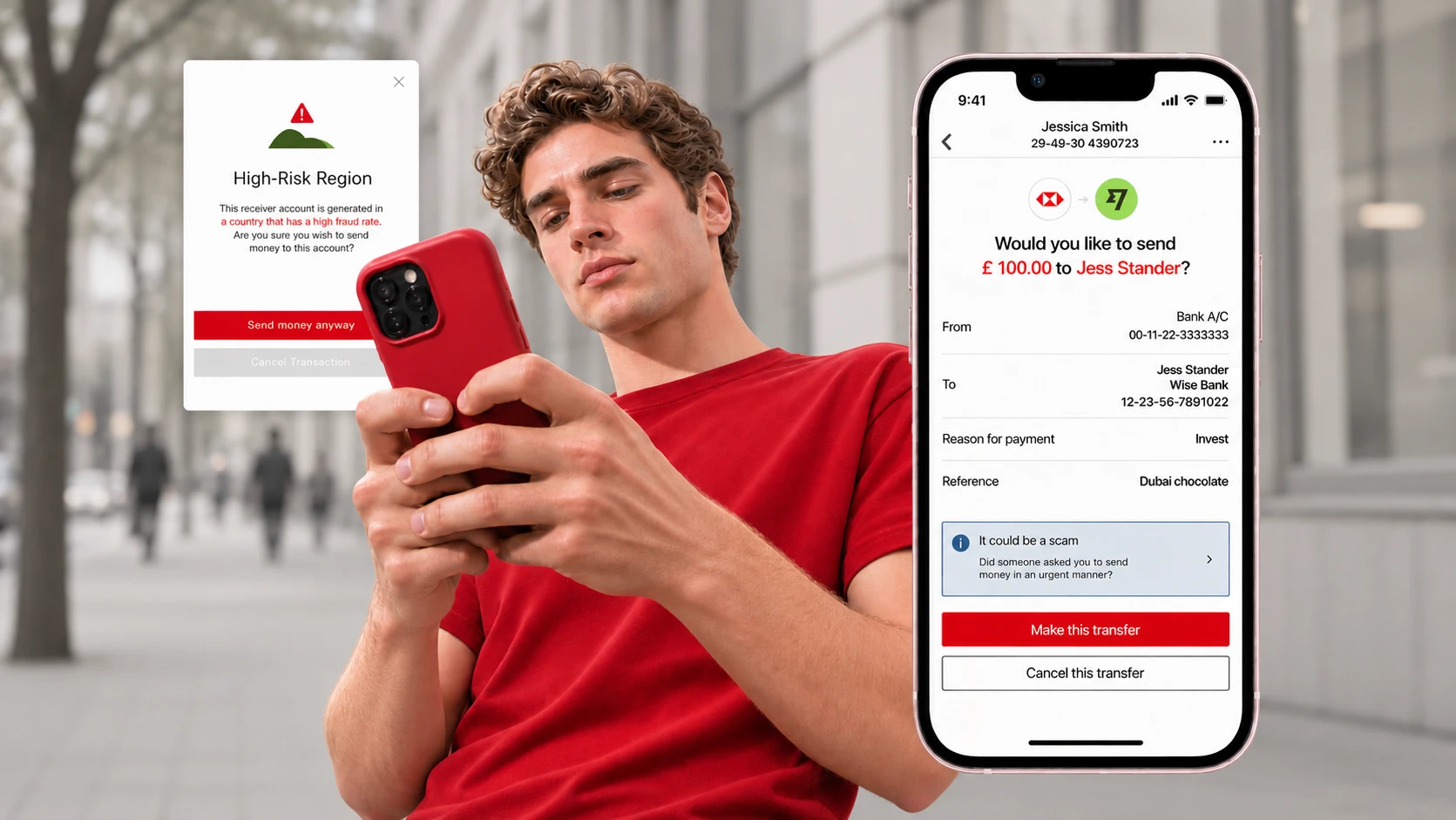
HSBC Redesign for Scam Prevention
Project Overview
Background
Bridging the gap between a user's perceived knowledge and their actual ability to detect a scam.
When users experience fraud, they often stop using HSBC entirely — meaning fraud must be prevented before it occurs, not just reimbursed after the fact.
Keywords
High Cognition Load
When user is busy on doing something the scam happens.
User Overconfidence
The biggest vulnerability in fraud prevention.
Evidence-Based Intervention
Applying the right brakes at the right time.
Main Features
Feature 01
Smart Intervention
Automated warnings that trigger during the transfer flow if the recipient's account is high-risk (e.g., newly created, flagged, or from a high-scam region).
Feature 02
Behavioral Micro-tips
Visual cues that debunk specific scam tactics (like "Safe Account" scams) on the loading screen before a transaction is finalized.
Feature 03
Quick Cancel from App Notification
Allows users to cancel unauthorized transactions directly from the push notification without opening the app, minimizing the "Window of Opportunity" for scammers.
Feature 04
Encouraging Lowering Transaction Limit
Before the scam happens, we suggest the bank's scam prevention method in advance, instead of expecting the user to already know.
Empathy
Secondary Research · Articles and Literature
Content coming soon
Primary Research · Survey
Users are overconfident — but only until scam actually happens.
Insight 01
Parallel to desk research, user overestimates their ability to recognize what banks will never ask for.
Evident 1. Around 60% of users think they know 2–4 rules they must not do against scam, which is relatively a lot to practice.
Evident 2. Around 60% of users think they can provide information to scammers that a bank will never ask from users.
Insight 02
Scam is not driven from lack of bank's scam explanation, but from absence of a real/fake detecting tool.
Evident 1. More than half of users say they understand why and what banks require.
Evident 2. However when roughly 70% of users face scam or scam-like messages they cannot tell if it is a scam.
Evident 3. Key anxiety triggers are "repeated verification, account lockouts, urgent wording, and complexity."
Primary Research · First Interview
Confidence to not be scammed is stronger than scam detection
Who
5 HSBC UK users who showed high confidence from the survey
How
1:1 conversation through Zoom call, 30–45 minutes
Num
Total of 5
Purpose
To check how they protect themselves from scam
From Affinity Group:
When users feel rushed, they are more likely to follow a scam attacker's instructions — but current banking experiences do not give an instant answer to help them escape from the panic moment.
From Testing:
Even confident users couldn't tell real HSBC texts from fake, so their scam-spotting ability may be overestimated. (from desk research and survey)
C
Could not even attempt to distinguish by saying "Actually cannot tell the difference at all, they all look fake"
D
Could not participate due to low eye sight
Define
User Persona
Digitally confident user whose risk emerges not from lack of skill, but from urgency, ambiguity, and time pressure.
Age
44
Occupation
career woman (non finance or tech)
Location
United Kingdom
Tech Literate
Enough to download app and use it but not expert enough to customize greatly
Bio
- Use HSBC mainly
- Busy career professional
- Handles finances on the go
- Proficient on using apps
- Uses mobile banking for basics
Pain points
- Inconvenient to manually cross-check numbers on the HSBC website or Googling
Needs
- No clear moment to distinguish real from fake
Age
30
Occupation
Busy working professional
Location
United Kingdom
Tech Literate
High — confident with digital banking
Bio
- Experienced £10,000 loss from scam
- After scam moved main bank from HSBC → Santander
- Digitally comfortable with app
- Manages finances independently and frequently multitasks
- Little clumsy
Pain points
- OTP is misunderstood as protection rather than a vulnerability
Needs
- Protection before irreversible actions (like inputting personal info on a real-like scam website)
- Slow me down when I'm rushed by urgency
User Journey 1
Verifying suspicion came with too much friction
Scenario : User receives an SMS claiming suspicious activity or policy-related action try to check if this it is scam or not
Initial Hypothesis 1
Verification becomes harder across fragmented touchpoints
When users try to verify a suspicious message, the information they need is spread across multiple touchpoints, including Google, the HSBC app, and the HSBC website. This fragmented experience increases cognitive load and makes users more vulnerable to mistakes under time pressure.
User Journey 2
When users are busy or distracted, the current system intervenes too late.
Scenario : User receives an SMS claiming to be from HSBC and lost money from putting personal info to scammer while User was busy to hang out with his friend
Initial Hypothesis 2
Risk awareness may break down under pressure
Scam prevention currently depends too much on users recognizing risks on their own. But in urgent situations, people are less able to think clearly, making it difficult to rely on awareness alone. Users need more direct and timely support.
Hypothesis Wrap-up
Based on two user stories above again two hypothesis were declared, which get evaluate later in UTs.
Initial Hypothesis 1
Verification becomes harder across fragmented touchpoints
Initial Hypothesis 2
Risk awareness may break down under pressure
User Story
Develop & Pivot: From Manual to Automated
- What: Iterating on the "Instant Verification" concept.
- How: Initially designed a manual "Message Verifier." However, UT1 revealed "Verification Inertia" — users felt checking a suspicious message was too much effort or unnecessary if they were already in a rush.
- Why: Pivoted to Contextual Smart Overlays. Instead of asking the user to verify, the system automatically analyzes the recipient's data and provides "evidence-based friction."
Iteration / Pivot Diagram
Deliver
High-Fidelity Design
- What: Final UI screens for the payment journey.
- How: Designed a 3-layer risk detection UI:
- Recency — Warning if the account is less than 3 months old.
- Location — Warning if the account belongs to a high-risk region.
- Social Proof — Warning if the account has multiple fraud reports.
Usability Testings
First Round · Concept Testing
Scam protection only works when it feels relevant
AimTo explore if all the functions are conceptually working in mid-fidelity stage
MethodThink aloud method and SUS · 45 minutes per person
Who5 HSBC account holders (4 did not get scammed, 1 got scammed)
Finding 01
Result
User does not find the "Instant Verification" function necessary. They believe it is unnecessary action because they feel they already know what is a scam or not.
Insight
We wonder if users know all the scenarios are fake because they haven't encountered a convincing one yet. Also start to think the first hypothesis could be wrong or not applicable.
Change
Redesign the UT2 to be more urging — prompting users to verify suspicious activity instead of leaving it optional.
Finding 02
Result
3 out of 5 users questioned why they had to go through extra verification when they did not see themselves as suspicious.
Insight
User expects scam prevention to focus more on the recipient than on the sender. So sender-focused verification feels unfair and unnecessary.
Change
Added contextual warning popups about the recipient account when a transfer shows unusual or high-risk patterns.
Second Round · Redesign Testing
More urgency, same rejection to verification function
AimTo evaluate whether a more urgent flow would encourage users to use the scam verification feature. Also to check if hypothesis 1 is right.
MethodThink aloud method and SUS · 45 minutes per person
Who5 HSBC account holders (all did not get scammed)
Finding 01
Result
Even after redesigning UT2 to feel more urgent and time-sensitive, 2 out of 3 users still refused to use the Instant Verification feature. Users continued to see it as an unnecessary step because they believed they could judge scams on their own.
Insight
The issue was not a lack of urgency, but a lack of perceived value. Users were overconfident in their ability to detect scams, so making the feature more urgent did not change their behavior.
Change
Removed Instant Verification as a separate optional feature and instead integrated scam prevention cues directly into the money transfer flow.
UT Reflection
Usability testing showed that the main issue was not simply the fragmented journey of verifying suspicious messages across multiple channels. More importantly, users were often unwilling to take extra steps to verify scams at all, even when urgency was increased. This revealed that the experience relied too heavily on users recognizing risk and acting on their own in moments of pressure.
Hypothesis 1 was invalidated
The fragmented journey itself was not the core issue.
Hypothesis 2 was validated
Under pressure, users' risk awareness broke down.
Final Design Direction
Instead of manual verification users could go through, give proactive warnings so users do not have to take extra steps but still remain safe.
Final Prototype
User Flow
Prototype
Business Objective
Business Objective
Reduce reimbursement and potential customer loss
Bridging the gap between a user's perceived knowledge and their actual ability to detect a scam. The users experienced fraud decides to stop using HSBC, which means that in order to keep the user, fraud needs to be prevented in advance.
Conclusion
Take away
This process showed that test delivery matters: tone, urgency, gesture, and pacing should all be considered as part of the protocol. However, it also revealed that changing the delivery of a task does not necessarily change user behavior. Even interview-based hypotheses can be clearly rejected in usability testing, reinforcing the need for behavioral validation.
Limitation
While 30+ participants joined the survey, the study lacks diverse perspectives from multiple scam victims (only 1 interviewed). Users who experienced scams showed higher skepticism towards the researcher's approach. With more time and outreach, having 4 more scam victims' voices would make this study more mature.